
Happy New year from the WELDNET Project! January, named after the two-faced Roman God Janus, who looked both backwards and forwards, is the perfect time to reflect on the achievements of the past year and how they lay the foundation for the coming year’s work. In this blog post we’ll give a summary of the WELDNET project’s work in 2025, broken down into the project’s different work packages (WPs) (illustrated below).
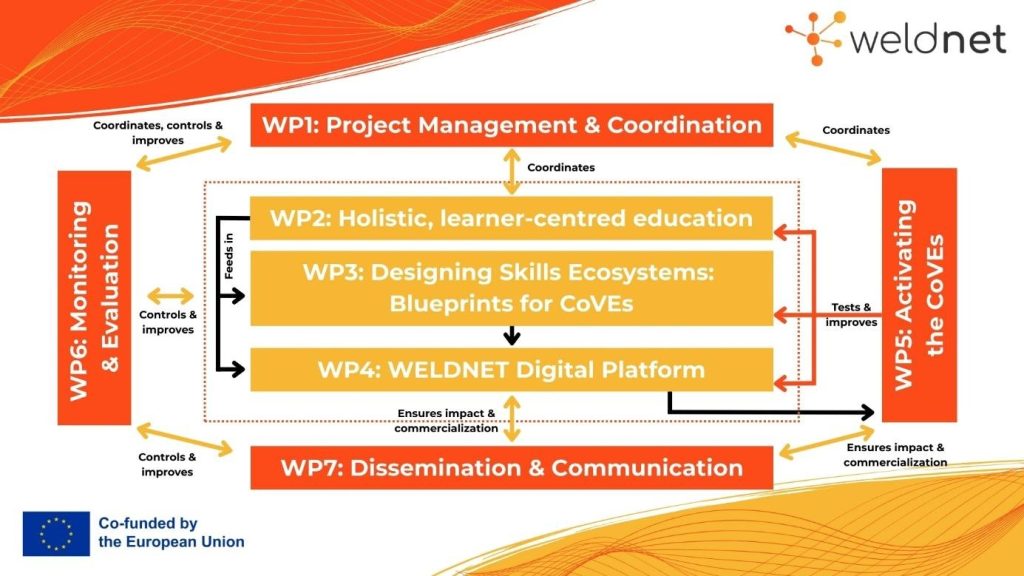
Work Package 1: Project Management & Coordination
Led by: Centre for Research & Technology Hellas (CERTH)
What were the key objectives of work package 1 in 2025?
This year, the Project Management and Coordination work package focused on ensuring effective governance, timely decision-making, and smooth collaboration between the project’s partners.
What did WP1 achieve in 2025?
Over the past 12 months, it has successfully coordinated project activities, monitored progress against milestones, managed risks and reporting obligations, and facilitated communication among the consortium.
What has been the contribution of WP1 to the WELDNET project objectives in 2025?
The efforts of the WP1 team have provided a stable operational framework that enables the technical activities of WELDNET to progress efficiently and in line with the project’s overall objectives.
Work Package 2: Holistic, learner-centered education
Led by: Centre for Research & Technology Hellas (CERTH)
What were the key objectives of work package 2 in 2025?
This year, the Holistic, learner-centered education work package concentrated on advancing a shared vision and strategic approach that places learners at the heart of the project’s educational ambitions.
What did WP2 achieve in 2025?
Over the past 12 months, effort was dedicated to guiding, aligning, and supporting activities in this area, while fostering reflection, dialogue, and continuous improvement across the consortium.
What has been the contribution of WP2 to the WELDNET project objectives in 2025?
This work contributes to the overall objectives of WELDNET by reinforcing a coherent, learner-focused foundation that underpins the project’s long-term impact and relevance.
Work Package 3: Designing Skills Ecosystems: Blueprints for CoVEs
Led by: Technical University of Vienna (TU Wien)
What were the key objectives of work package 3 in 2025?
One of the key objectives of work package 3 (Designing Skills Ecosystems: Blueprints for COVEs) in 2025 was to envision the future of the CoVEs by carrying out strategic foresight workshops in each region. The aim was to imagine both ideal and realistic scenarios regarding the future of the CoVEs. Another key objective for the first project year was to develop a “Self-Assessment Tool”. This will be implemented in WELDNET as an assessment tool for VET institutions that want to become epicenters of Inclusive and Holistic Skills Ecosystems via the five COVEs.
What did WP3 achieve in 2025?
The blueprint for the future of the CoVEs (Task 3.1) has been completed by project partner HELIX, in close cooperation with each regional ecosystem. The Self-Assessment Tool (Task 3.2) has been developed in form of a matrix by CESOL and HELIX. Relevant contributions from other EU education-assessment tools (reviewed and in some cases already applied) have also been documented. The first draft of the Seals of Excellence Guidelines (Task 3.5) has been developed and shared with the partners and is currently undergoing review. Planning for the remaining tasks has begun, and the corresponding deliverables will be shared with partners in the new year.
What has been the contribution of WP3 to the WELDNET project objectives in 2025?
The CoVE blueprint serves as the operational and strategic framework for establishing the 5 CoVEs across the 5 WELDNET regions. It provides a shared architecture for creating living-lab-based Skills Ecosystems. The strategic priorities identified through the regional foresight workshops have been consolidated into five main themes.
The Self-Assessment Tool will function as a starting point for VET institutions aiming to position themselves as epicenters of Inclusive and Holistic Skills Ecosystems via COVEs within the WELDNET project. The completed tasks in WP3 will contribute to the development of the digital framework in WP4 and the piloting phase in WP5.
Work Packages 4 & 5
WP4: The WELDNET Digital Platform (led by YET) and WP5: Activation of the CoVEs (led by Asociación Española de Soldadura y Tecnologías de Unión (CESOL)) are due to begin work later in the project (in August 2026 and March 2027, respectively). For this reason, we’ll now jump ahead to WP6.
Work Package 6: Monitoring & Evaluation
Led by: HelixConnect
What were the key objectives of work package 6 in 2025?
Within the WELDNET project, aimed at developing Inclusive and Holistic Skills Ecosystems across five European regions, WP6 ensures that all activities and outputs are delivered with high quality, transparency, and methodological coherence. In 2025, WP6 focused on establishing a unified quality and monitoring architecture to support the project’s ambition of strengthening VET excellence, safety culture and sustainable upskilling. Key objectives included developing the Quality Assurance Plan with Key Performance Indicators (KPIs) and procedural guidelines (Task 6.1), launching periodic quality reviews (Task 6.2), preparing the tender and criteria for selecting the External Evaluator (Task 6.3), and outlining the External Evaluation Strategy (Task 6.4), which will guide independent assessment across all work packages.
What did WP6 achieve in 2025?
WP6 delivered several foundational components essential to WELDNET’s implementation. The Quality Assurance Plan (Task 6.1) was completed, providing partners with clear standards, reporting templates, compliance rules, and monitoring procedures aligned with the project’s expected outcomes. The first semestrial quality review cycle began (Task 6.2), enabling systematic assessment of each work package and ensuring traceability of project actions. WP6 also prepared and disseminated the call for the External Evaluator (Task 6.3), establishing a transparent two-stage selection process. Significant progress was made on the External Evaluation Strategy (Task 6.4), defining data sources, analytical tools, timelines, and evaluation workflows to measure WELDNET’s progress and impact.
What has been the contribution of WP6 to the WELDNET project objectives in 2025?
The work completed in WP6 directly strengthens WELDNET’s capacity to deliver high-quality and impactful outcomes across training, safety, digitalisation, and ecosystem development. By establishing a harmonised quality assurance and monitoring framework, WP6 ensures that progress is measurable, comparable, and aligned with the project’s mission to create sustainable Centres of Vocational Excellence in welding and metalworking. Periodic reviews enable early detection of risks and support evidence-based decision making, while the external evaluation mechanisms ensure transparency and credibility. Through these processes, WP6 safeguards the project’s integrity and helps ensure that WELDNET’s results are reliable, scalable, and suitable for long-term exploitation.
Work Package 7: Dissemination & Communication
Led by: EIT Manufacturing East GmbH
What were the key objectives of work package 7 in 2025?
The key objectives of the Communications & Dissemination work package were the establishment of WELDNET’s visual identity, design of its logo and promotional materials, set-up of its website and social media channels, and development and implementation of its communications strategy. The goals of this work are to begin building an audience and draw attention to the training opportunities that will be offered by the WELDNET Centres of Vocational Excellence (CoVEs).
What did WP7 achieve in 2025?
The partners have been working closely together throughout the year to set up the project’s communication channels, particularly the LinkedIn and Facebook profiles. They have also worked to establish and populate the project’s website. In addition, project partners have represented the project at numerous events both in and beyond Europe to promote the work being done and the CoVEs we are working on building. A key milestone in this was the submission of the WELDNET Communication and Dissemination Plan (Project Deliverable 7.1) in May 2025. This document not only set out the KPIs that will provide evidence of the impact of successful communication but acts as a roadmap for reaching them.
What has been the contribution of WP7 to the WELDNET project objectives in 2025?
The communication and dissemination strategy runs as a thread through all the other work packages and acts in synergy with them. The raising of awareness about the project and the CoVEs it is setting up will contribute to the uptake of training and education in the relevant target countries.
So, now we’ve learned what the WELDNET project has been up to in 2025, it’s time to look forward to 2026! Follow the project on social media to keep up to date with all the latest news!