
In the field of critical infrastructure, Joining Technologies play a silent but decisive role. Recent media attention on railway welding has highlighted the importance of specialized technical knowledge, an area in which CESOL has been positioning itself as a benchmark for decades.
Through its training, certification, and outreach work, CESOL continues to promote excellence in welding and materials, contributing directly to the safety and reliability of strategic sectors such as railways.
CESOL’s technical recognition was recently highlighted following the Adamuz railway accident. On January 20 CESOL’s technical director, Juan Vicente Rosell, a metallurgical engineer, appeared on Antena 3’s program “Y ahora Sonsoles.” He subsequently appeared on Telecinco’s 9:00 p.m. news program on January 22. On January 27, he returned as a technical expert on several programs, including Antena 3 “Espejo Público,” Telemadrid’s news programs, and Cuatro “Todo es Mentira.”
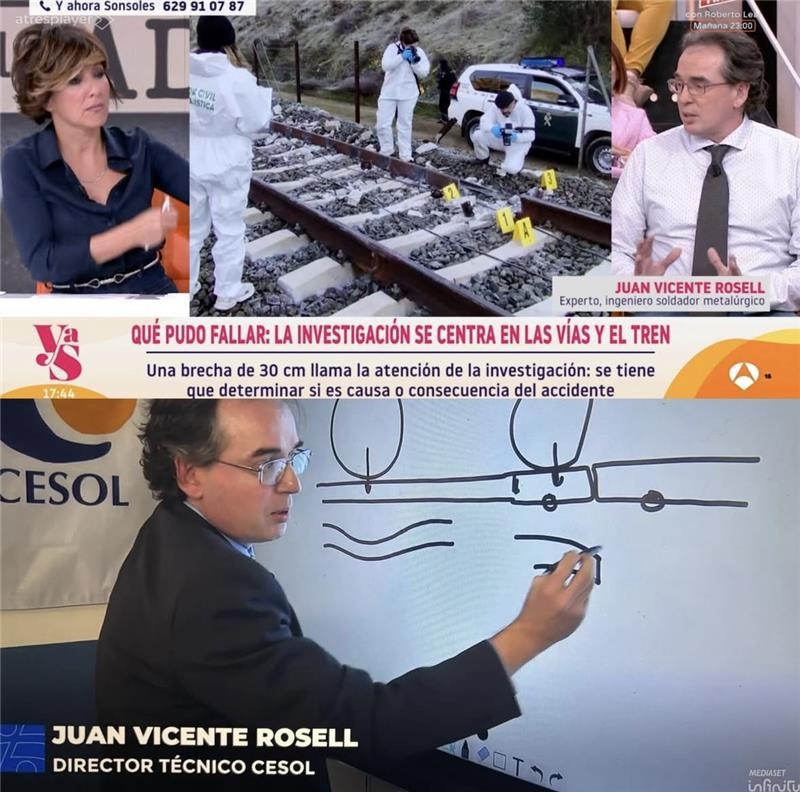
During his appearance, CESOL’s technical director explained how aluminothermic welding is carried out on railway tracks and why this point is key in any railway investigation. Among the technical aspects highlighted were the aluminothermic reaction process for joining rails, the need for precise geometric preparation, thermal control during execution, and the importance of the final finish and subsequent inspection.
Thanks to its ability to transfer specialized knowledge to both society and professionals in the sector, CESOL consolidates its position as a technical benchmark in the field of Joining Technologies. Its commitment to training, certification and a rigorous dissemination once again demonstrates that CESOL continues to be at the forefront of these technologies, contributing decisively to the development of safer and more reliable railway infrastructures.