
When President Ursula von der Leyen took the podium in Strasbourg for her second State of the Union address, the word “skills” appeared again and again: it was one of the pillars holding up her entire vision of a more competitive, independent Europe. For a project like WELDNET, built precisely on the premise that skills gaps are holding back Europe’s manufacturing sector, this year’s address is validation of the work already happening on the ground in our five partner regions.
Skills as “the bridge between uncertainty and opportunity”
The Commission’s State of the Union 2026 report is clear about the scale of the challenge the union is facing: fragmented markets, high energy costs, and, explicitly named alongside them, skills shortages are described as structural barriers holding European businesses back. This isn’t a side issue either: the report frames skills as central to whether ordinary workers experience Europe’s economic transformation as a threat or as an opportunity, especially “in a moment of geopolitical tension and technological upheaval” when many workers are anxious about what automation, AI, and industrial restructuring will mean for their jobs.
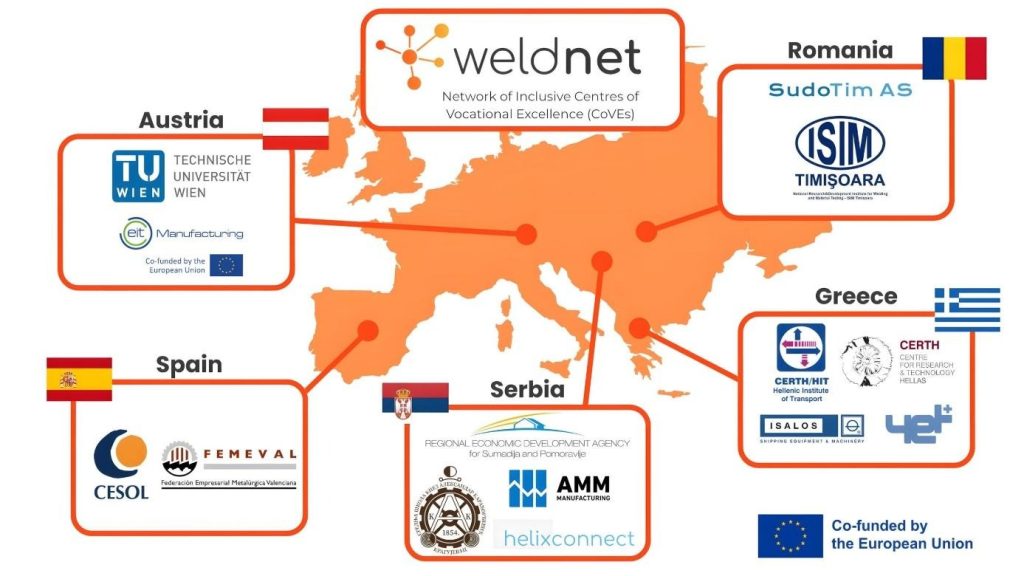
This is exactly the anxiety WELDNET was designed to address, just in a very specific corner of the economy: the automotive supply chains in Austria, the Central Macedonia region in Greece, Romania’s West Region, Šumadija & Pomoravlje in Serbia, and Valencia in Spain, where circular material welding and predictive maintenance are becoming increasingly important competences as manufacturers shift towards integrating recycled and reused metals into their supply chains.
The numbers behind the ambition
The Commission points to real momentum already built through its Union of Skills initiative: more than 10 million people have gone through upskilling or reskilling programmes since 2020. It also sets out EU-wide targets for 2030: at least 78% of the working-age population in employment and at least 60% of adults in training every year. Furthermore, it outlines a new Skills Guarantee meant to help workers move out of declining sectors and into the growing, strategic ones that face labour shortages.
That last point matters enormously for WELDNET. Our whole model (five Centres of Vocational Excellence combining initial (IVET) and continuing (CVET) training) is a regional, hands-on version of just this ambition: helping welders, maintenance technicians and new entrants (including people with disabilities, migrants, and workers from marginalised communities) move into roles the automotive sector is actively creating, rather than being left behind by its transformation.
Quality jobs, not just any jobs
Von der Leyen was also careful to link competitiveness to job quality, not just job creation. The forthcoming Quality Jobs Act, built on a roadmap negotiated with European social partners, aims to ensure fair wages, strong health and safety standards, and smoother transitions between sectors. For an industry like welding and metalworking, where safety has always been inseparable from skill, this is a welcome signal. As we’ve argued before on this blog, tomorrow’s welders need new skills for a circular economy, and that includes the judgment to work safely with materials whose history and composition are less predictable than virgin metal.
Industry is changing faster than training systems
The Commission’s broader industrial agenda, which is pushing to lift manufacturing’s share of EU GDP from 14.3% to 20% by 2035, the Clean Industrial Deal, and the Twin Transition all assumes a workforce that doesn’t yet fully exist. That gap between industrial ambition and available talent is the challenge Centres of Vocational Excellence like ours is seeking to overcome, and why partnerships between industry, training providers and regional authorities (the “knowledge triangle” WELDNET was built around) are being pushed up the EU’s policy agenda rather than treated as a technical afterthought.
What this means for WELDNET going forward
None of this changes WELDNET’s mission, but it does sharpen the sense that our five CoVEs are operating right at the intersection of Europe’s stated priorities: industrial competitiveness, the green transition, and social inclusion through skills. As the Commission moves from “promise to progress” (the title it gave this year’s report) projects like ours are where that progress will actually be measured: in welding bays, maintenance workshops, and classrooms across five regions, one trained worker at a time.