
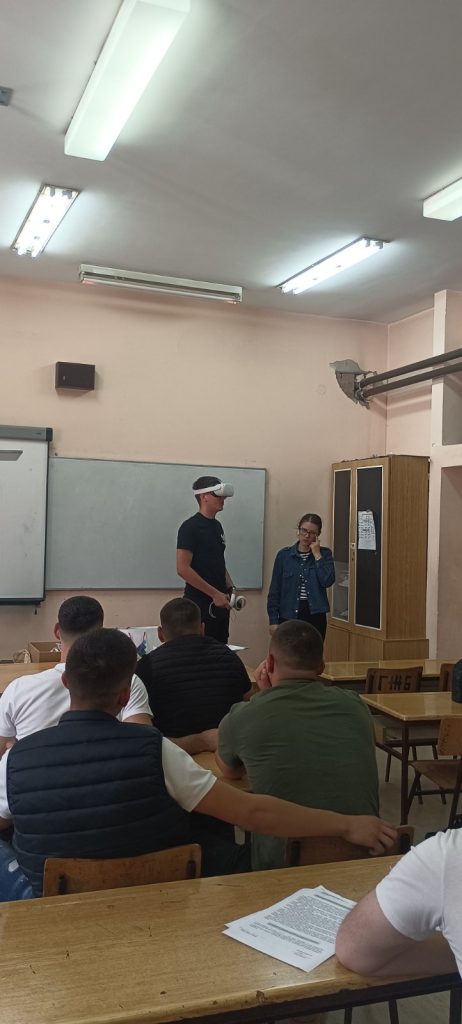
Picture a trainee welder in Timișoara, or Valencia, or Thessaloniki. She’s wearing a welding helmet and holding a torch, but there is no arc, no fume extraction fan whirring in the background, and no risk of a burn if her hand slips. The bead she is laying down exists only in a headset, yet the feedback she receives on her arc length, travel angle and welding speed is precise enough to shape how she’ll weld for the rest of her career. This is not a glimpse of some distant future. It is happening in vocational classrooms across Europe right now, and it may be one of the most important tools we have for closing the welding skills gap.
- A shortage that traditional training can’t out-run
As WELDNET has highlighted from the start, the European Union is short of more than half a million qualified welding and maintenance professionals, and existing VET centres are struggling to keep pace through initial or continuing training alone. Part of the problem is structural. Traditional welding instruction is expensive: every metre of practice weld consumes real metal, real gas and real electrode, and a training bay can only host one learner at a time under an instructor’s direct supervision. Beginners are also, understandably, a little afraid of arc flash, fumes and burns before they’ve built any confidence, and that hesitation slows everyone down. For adults trying to reskill into the trade through continuing vocational education (CVET), fitting scarce workshop hours around an existing job is another barrier entirely.
None of this is a new observation. A widely cited review of virtual and augmented reality in welding training notes that conventional instruction is very costly in terms of material, time, and infrastructure, and that students need extensive hands-on practice simply to become competent. The demand for that practice time is exactly what simulators are now being used to absorb.
- What VR and AR simulators actually do
Modern welding simulators, such as the widely used VRTEX systems and various university-built platforms, place an instrumented torch in the trainee’s hand and track it in three-dimensional space. As the learner moves the torch, the system monitors the same parameters a real instructor would watch for: arc length, work angle, travel angle and travel speed. Instead of waiting for a weld to cool and be cut open for inspection, the trainee sees immediate visual and sometimes haptic feedback on bead quality and defects.
The research backing this approach is now reasonably substantial. Studies gathered across multiple reviews report that XR (extended reality) welding simulators improve welding performance outcomes including weld quality scores, welding parameter scores, and dexterous abilities, particularly in the early stages of learning, where simulators increase student engagement, reduce material waste and training costs, and allow novices to develop basic torch handling skills before moving to the workshop. A 2026 study using a Meta Quest-based VR system with total beginners similarly found that structured VR sessions could enhance fundamental welding education by offering a safe, repeatable, and effective practice environment that simultaneously improves technical performance, strengthens learner confidence, and reduces training-related anxiety.
Institutions that have already adopted this technology report similar experiences on the ground. At RMIT University in Australia, one of the first cohorts to train on a virtual welding simulator noted that using it early would have saved a lot of errors, mistakes, and wasted materials, while staff pointed out that beginners could get a feel for the process and practice technique without the noise, heat and mess of a live welding bay.
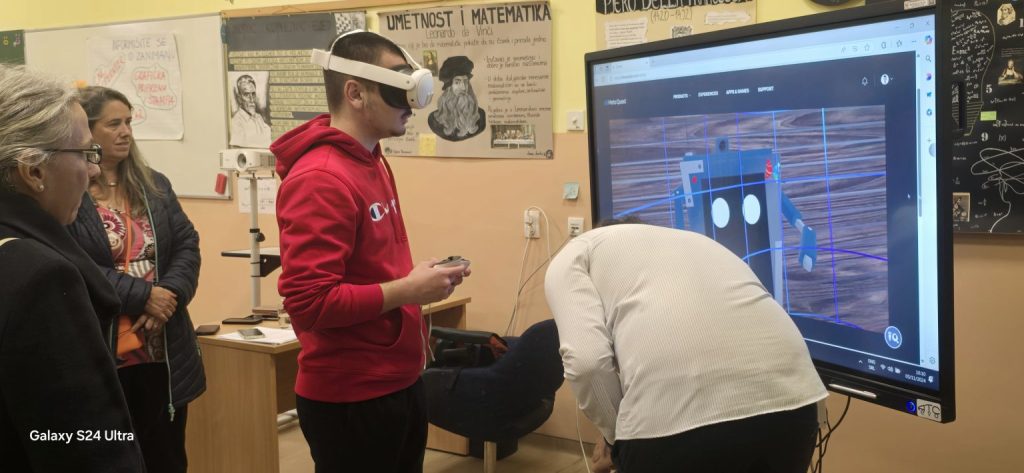
Where AI increasingly enters the picture is in personalisation. Rather than a fixed scoring rubric, adaptive systems can flag a trainee’s specific recurring error, such as a consistently unstable travel angle, and adjust the difficulty or the feedback accordingly, moving training from generic instruction towards something closer to one-to-one coaching at scale.
- Why this matters for inclusion, not just efficiency
For WELDNET, the appeal of this technology goes beyond cost savings. Simulators lower several of the practical barriers that keep people out of the trade in the first place. A learner with a physical disability that makes prolonged standing or heavy protective equipment difficult can begin training in a lower-intensity virtual environment before progressing to live practice. Someone in a rural area without easy access to a fully equipped workshop can start building foundational skills with comparatively modest equipment. And for career-changers, refugees or members of minority communities who may find a live welding bay intimidating on day one, a virtual environment offers a lower-stakes way to build confidence before the stakes (and the sparks) become real.
This aligns closely with WELDNET’s own mission of designing learner-centred IVET and CVET pathways for people with disabilities, migrants and individuals from minority groups across its five partner regions, and with the wider ambition, shared with initiatives like the Automotive Skills Alliance, of building a workforce that is both larger and more representative of the communities it serves.
- A natural fit for circular material welding
There’s also a more specific reason this technology matters to WELDNET’s core focus (along with its sister projects WELDIFY) on circular material welding (CMW). Recycled and reclaimed metals do not always behave as predictably as virgin stock. Prior stress, variable composition and contamination can all affect how a joint responds to heat. Simulated training environments make it possible to model these trickier, less forgiving materials and let trainees practise on “difficult” virtual metal long before they touch genuinely difficult scrap-derived stock in a live setting. The same logic extends naturally to WELDNET’s other sister project, PreMETs’, preventive maintenance systems (PMS) training, where simulated equipment faults can teach diagnostic skills without needing to wait for (or induce) a real failure.
- What simulators can’t replace
It would be misleading to suggest that a headset can fully substitute for a welding bay. Research shows that although most XR training systems perform well on engagement and short-term skill measures, there is not always clear evidence that skills learned in XR transfer seamlessly to real-world practice. Physical dexterity under genuine heat, the smell and sound cues experienced welders rely on, and the teamwork of a live workshop floor are all things a screen cannot fully replicate.
The most credible position, and the one increasingly reflected in vocational curricula, is that simulators are best treated as one stage within a blended training pathway rather than a replacement for hands-on practice. Trainees build foundational muscle memory and confidence virtually, then transfer into supervised live welding once the basics are secure, arriving at the workshop already competent rather than starting from zero.
- The road ahead for Europe’s CoVEs
As WELDNET’s five Centres of Vocational Excellence continue to design their regional training offers, blended learning models that combine virtual practice with hands-on instruction are exactly the kind of tool that could help each CoVE do more with limited workshop capacity, particularly when reaching adult learners balancing training with existing work, or newcomers for whom a welding bay is an unfamiliar and daunting place. Welding’s future in Europe will not be shaped by steel and electrodes alone. Increasingly, it is being shaped in a headset, long before the first real spark ever flies.
Interested in how WELDNET’s Centres of Vocational Excellence are approaching welding training? Get in touch or follow our news page for updates from all five regions.